
Major Shaitan
Singh Bhati
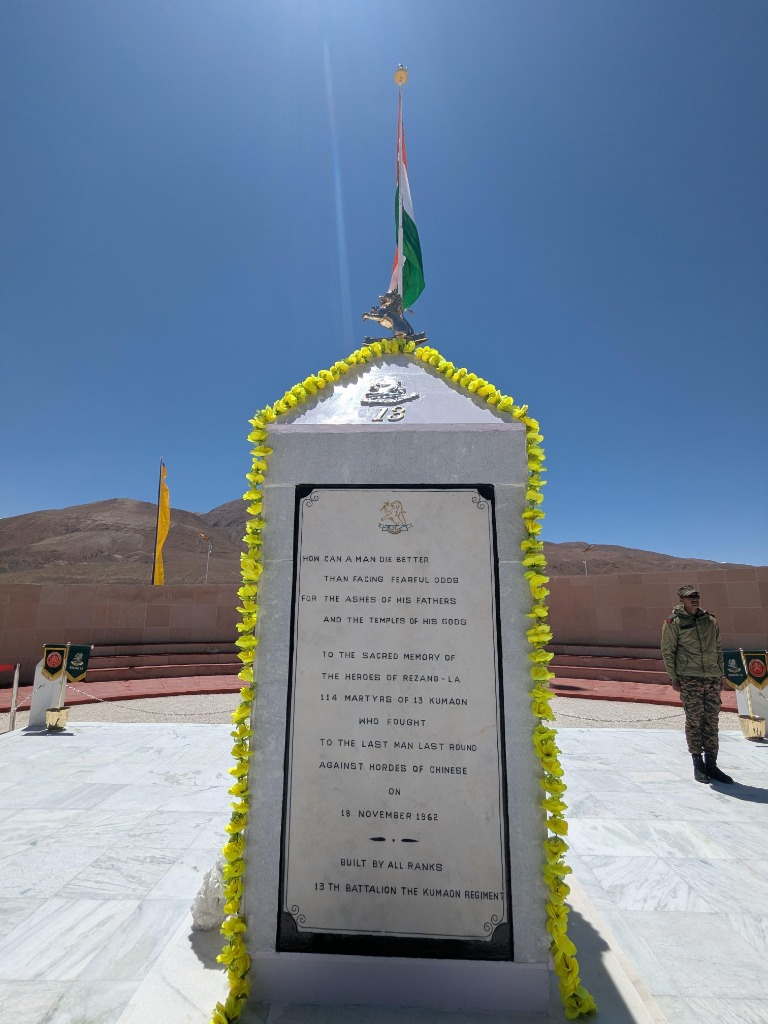
"How can a man die better than facing fearful odds, for the ashes of his fathers and the
temples of his gods."
For some, these are words. For Major Shaitan Singh Bhati, they became a life lived in quiet
courage and a sacrifice that echoes across generations.
Major Shaitan Singh Bhati, PVC
Major Shaitan Singh Bhati (1 December 1924 – 18 November 1962) was an officer of the Indian Army
and a recipient of the Param Vir Chakra, India’s highest wartime gallantry award.
Early Life
& Values
Born in Jodhpur into a distinguished military family, he was the son of Lieutenant Colonel Hem
Singh Bhati. From an early age, he was shaped by values of discipline, service, and
responsibility.
He completed his education at Chopasni Senior Secondary School, where he was known for his
academic dedication, strong character, and outstanding performance in football.
Service &
Leadership
Commissioned into the Indian Army, he served with the 13 Kumaon Regiment. In November 1962,
during the Indo China conflict, he commanded ‘C’ Company at Rezang La in Ladakh.
On November 1962, at Rezang La in Ladakh, as part of the 13 Kumaon Regiment, he led his men
under impossible conditions.
Outnumbered.
Outgunned.
But never outmatched in spirit.
The Last
Stand
Moving from post to post under heavy fire, he continued to lead, inspire, and stand beside his
men until his last breath.
It was not just bravery.
It was leadership in its purest form.
Sacrifice &
Legacy
Major Shaitan Singh laid down his life in the line of duty, upholding the highest traditions of
the Indian Army.
For his conspicuous bravery, inspiring leadership, and supreme sacrifice, he was posthumously
awarded the Param Vir Chakra.
But his legacy lives beyond medals.
It lives in the silence of Rezang La.
In the stories passed down.
In every act of courage that asks for nothing in return.
His legacy continues to inspire generations and is remembered till today.